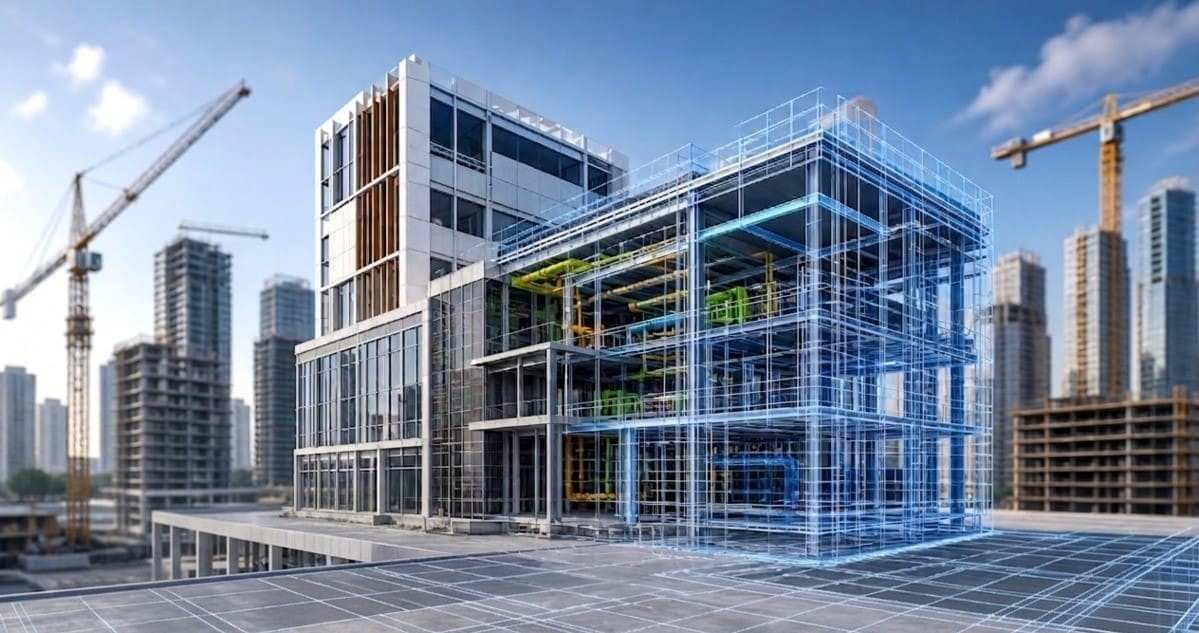
Building Information Modeling (BIM) is now widely used in the construction industry. It helps architects, engineers and contractors plan, design and manage projects more efficiently. As projects become more complex, using BIM has become important for better coordination and accurate results.
In this guide, you will learn what Building Information Modeling (BIM) is, along with its key benefits, common applications and the main BIM tools and software used in the industry.
What is Building Information Modeling (BIM)?
BIM Definition and Meaning
Building Information Modeling (BIM) is a digital process used in construction to create and manage project information. It involves developing a 3D model that includes both design and important data such as materials, costs and specifications.
BIM is not just software. It is a method that supports the entire project lifecycle, from planning and design to construction and maintenance.
How BIM Works in Construction
BIM works through a shared digital model that all project teams can access. Architects, engineers and contractors work on the same model, which improves coordination.
Each element in the model contains data. For example, a wall includes details like size, material and cost. When one part of the model changes, related elements update automatically.
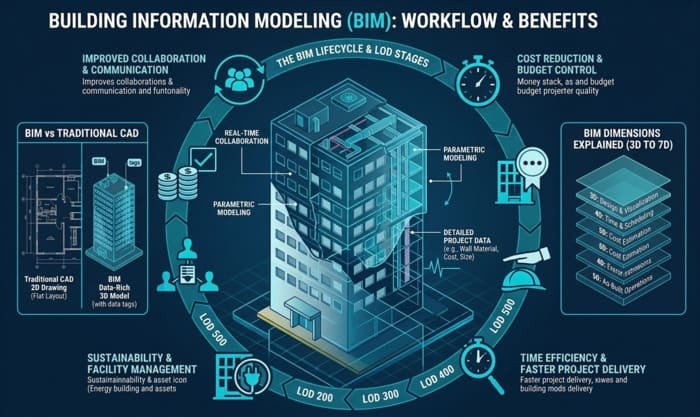
BIM vs Traditional CAD
Traditional CAD is mainly used for creating 2D drawings or simple 3D designs. It does not include detailed project data.
BIM, however, creates a data-rich model. It helps with planning, cost estimation and project management.
In simple terms, CAD shows the design, while BIM provides complete project information.
Key Features and Components of BIM
Core Features of BIM
One key feature of BIM is parametric modeling. This means that changes in one part of the model automatically update other related parts.
BIM also supports real-time collaboration. Multiple team members can work on the same model at the same time.
BIM Levels of Detail (LOD)
Not every stage of a project needs the same level of detail. BIM uses Levels of Detail (LOD) to define how much information a model should have at each stage.
LOD 100: Basic concept stage. Elements are simple shapes showing size and layout. No exact details.
LOD 200: Early design stage. Elements have approximate size and position but are not final.
LOD 300: Detailed design stage. Elements include exact dimensions, materials and specifications. Used for construction drawings.
LOD 400: Fabrication stage. Models include enough detail for manufacturing and installation. Common in MEP and structural work.
LOD 500: As-built stage. The model shows the final built condition, including any changes made on-site. Used for building management.
BIM Dimensions Explained
BIM is also defined by dimensions. Each dimension adds more information to the model.
3D BIM – Design and Visualization: 3D BIM is the base model. It shows the building in three dimensions with accurate shapes and positions.
4D BIM – Time and Scheduling: 4D BIM adds time to the model. Each part of the project is linked to a schedule.
5D BIM – Cost Estimation: 5D BIM includes cost information. The model updates costs automatically when design changes.
6D BIM – Sustainability: 6D BIM focuses on energy use and environmental impact.
7D BIM – Facility Management: 7D BIM is used after construction. It includes data for maintenance, repairs and operations.
Benefits of BIM in Construction
Improved Collaboration and Communication: One of the main benefits of BIM is better collaboration. All teams work on the same model, which improves communication..
Enhanced Visualization and Design Accuracy: BIM provides clear 3D models. These help teams understand the design before construction begins.
Cost Reduction and Budget Control: BIM supports accurate cost estimation. It helps project teams plan budgets and reduce unexpected costs.
Clash Detection and Error Reduction: BIM can detect clashes between systems, such as structural and mechanical parts.
Time Efficiency and Faster Project Delivery: Better planning and coordination help complete projects on time.
Sustainability and Lifecycle Management: BIM supports sustainable construction by improving material use and energy planning.
BIM Applications Across Industries
BIM is not limited to standard building projects. Today, it is used in many industries because it improves accuracy, coordination and data management.
Commercial and Residential Construction
BIM is most commonly used in commercial and residential projects. It helps design and manage buildings such as offices, shopping centers, hotels and housing developments.
Teams use BIM to coordinate different systems, manage costs and reduce mistakes during construction. This makes it a reliable method for large and complex projects.
Infrastructure and Civil Engineering
BIM is widely used in infrastructure projects like roads, bridges, tunnels, railways and airports.
It helps engineers plan designs more clearly, calculate materials accurately and manage construction in difficult conditions. BIM also allows teams to simulate the construction process before work begins, which reduces risks and improves efficiency.
Healthcare Construction
Healthcare buildings, such as hospitals, are complex and require careful planning. They include advanced systems and must follow strict regulations.
BIM helps teams design and coordinate these systems properly. It also supports planning construction in phases, so existing facilities can continue operating without interruption.
Transportation and Metro Systems
Large transportation projects, such as metro systems and rail networks, use BIM to manage complex work.
It helps in planning routes, designing stations and coordinating multiple teams. BIM also improves safety and quality by allowing better control over the construction process.
Renovation and Refurbishment
BIM is also useful for renovation projects. It helps create accurate digital models of existing buildings.
When combined with technologies like 3D scanning, BIM allows teams to plan upgrades and repairs more precisely. This reduces errors and improves the overall quality of the work.
BIM Tools and Software
Types of BIM Tools
Different BIM tools are used at different stages of a project. Each tool has a specific purpose in the overall workflow.
Authoring tools: Used to create 3D models
Coordination tools: Used for collaboration and clash detection
Analysis tools: Used to test design performance
Visualization tools: Used for presentations and walkthroughs
Cost estimation tools: Used for budgeting and quantity takeoffs
Popular BIM Software
Several software solutions are commonly used in the BIM industry. Each one supports different project needs.
- Autodesk Revit: Widely used for architectural and structural modeling
- Navisworks: Used for project coordination and clash detection
- ArchiCAD: Popular for architectural design and modeling
- Tekla Structures: Focused on structural engineering and detailing
- Bentley Systems: Used for large infrastructure and civil projects
How to Choose BIM Software
Selecting the right BIM software is important for smooth project delivery. A few key factors include:
- Project type and complexity
- Budget and licensing cost
- Compatibility with other tools
- Team experience and training level
Challenges of BIM Implementation
Even though BIM is powerful, it also comes with some challenges.
- High Initial Cost
- Need for Skilled Professionals
- Software Compatibility Issues
- Resistance to Change
Future of BIM Technology
BIM is continuously evolving and becoming more advanced.
Integration with AI and Automation: Artificial intelligence is making BIM smarter by improving design predictions and automation.
Digital Twins and Smart Buildings: BIM is now used to create digital twins, real-time digital copies of buildings that help monitor performance.
Cloud-Based Collaboration: Cloud systems allow teams to work on the same model from different locations, improving coordination.
Sustainable Construction: BIM is helping the industry design more energy-efficient and environmentally friendly buildings.
BIM vs CAD: Which is Better?
BIM and CAD are often compared, but they serve different purposes.
- CAD focuses on drawing and design
- BIM focuses on data, coordination and project management
Conclusion
Building Information Modeling (BIM) has become an essential part of modern construction. It improves design accuracy, reduces errors and helps manage costs and time more effectively.
Its use across industries shows its importance in both small and large-scale projects. As technology continues to grow, BIM will play an even bigger role in shaping the future of construction.
Frequently Asked Questions
No, BIM is not limited to large projects. It is now used in small and medium projects as well. Even small contractors use BIM. However, its full value is more visible in complex projects.
BIM does not completely replace traditional methods, but it improves them. It works alongside construction practices to make planning, design and execution more accurate and efficient.
3D modeling only shows visual design. BIM goes beyond that by adding data such as cost, materials, scheduling and maintenance information.
BIM is widely used in countries like the UK, USA, UAE, Singapore and parts of Europe where governments have made it mandatory or strongly encouraged its use in public projects.
In many countries, yes. Governments often require BIM for public infrastructure projects to improve transparency, reduce cost overruns and improve project delivery.