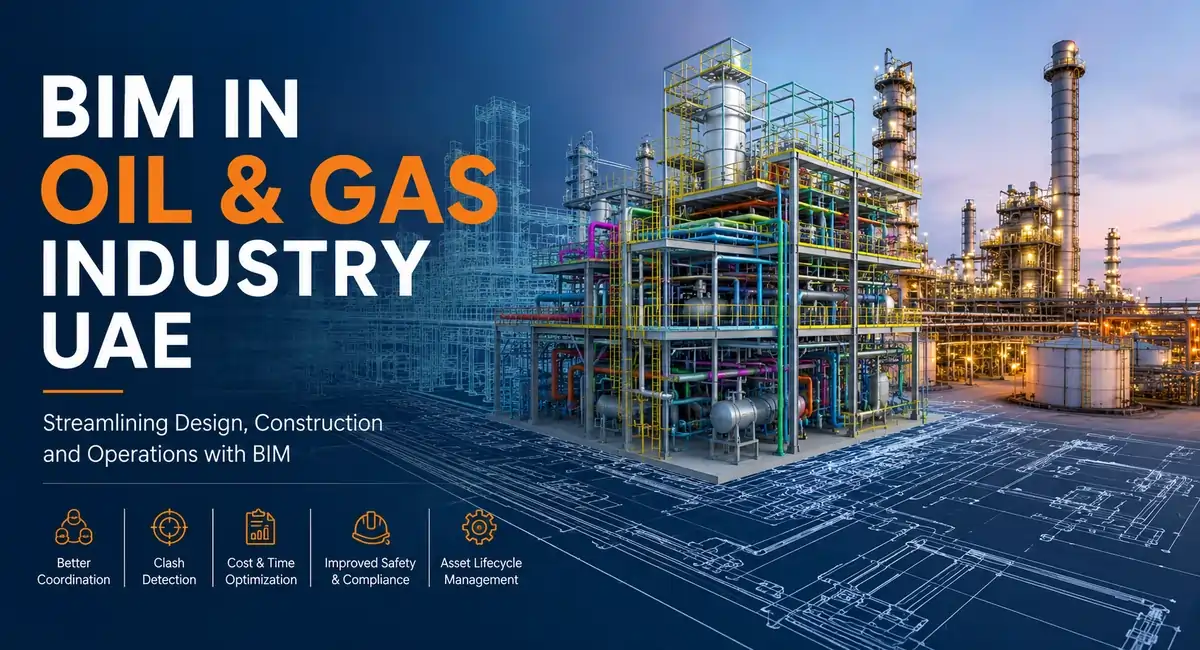
The UAE oil and gas sector is adopting advanced digital technologies to improve project efficiency and reduce operational challenges. As industrial projects become more complex, the use of BIM in oil and gas projects is increasing across Dubai and the wider UAE.
Today, BIM in oil and gas industry projects helps companies improve planning, coordination and construction accuracy. From refineries to offshore facilities, BIM allows teams to manage complex systems through intelligent 3D models and real-time collaboration.
The growing demand for BIM implementation in Dubai is also supporting the UAE’s vision for smart and sustainable infrastructure development.
What is BIM in the Oil and Gas Industry?
Building Information Modeling (BIM) is a digital process used to design, manage and coordinate construction projects through intelligent 3D models.
In the energy sector, BIM solutions for oil and gas sector projects help engineers and contractors improve coordination between structural, mechanical and pipeline systems. Through 3D BIM modeling, teams can identify design conflicts before construction begins, reducing delays and costly rework.
The use of BIM is especially valuable for large industrial facilities where accurate planning and collaboration are essential.
Key BIM Technologies Used in Oil and Gas Projects
Several technologies are driving the adoption of BIM across industrial construction projects in the UAE.
3D plant modeling helps teams visualize equipment layouts and facility structures before construction starts. Meanwhile, 4D BIM scheduling improves project sequencing by linking construction activities with timelines.
Companies also use 5D BIM cost estimation to manage project budgets more effectively. In addition, a Common Data Environment (CDE) allows all stakeholders to access updated project information from a centralized platform.
Many firms are now integrating digital twin technology with BIM to improve operational performance and facility management.
Why the UAE Oil and Gas Industry is Adopting BIM
The increasing scale of UAE energy infrastructure projects is driving the need for smarter construction solutions. BIM helps companies improve coordination, reduce risks and manage projects more efficiently.
The rise of smart infrastructure UAE initiatives and sustainable construction practices is also accelerating BIM adoption across the industrial sector. As a result, the demand for BIM consultancy UAE services continues to grow in Dubai and Abu Dhabi.
Applications of BIM in Oil and Gas Projects
The use of BIM is expanding across multiple areas of the UAE energy sector. Companies are using digital technologies to improve coordination, reduce delays and manage industrial infrastructure more efficiently.
Refineries and Petrochemical Plants
Modern refinery projects involve highly complex systems that require accurate coordination between engineering teams. Through BIM for refinery projects, companies can improve design accuracy and reduce construction conflicts before work begins.
Offshore Platforms
Offshore projects require precise planning because of limited working space and complex structural systems. BIM allows project teams to coordinate layouts more efficiently and improve communication between stakeholders during the design and construction stages.
Benefits of BIM in Oil and Gas Industry
The adoption of BIM in oil industry projects continues to increase because of its operational and construction advantages.
Key benefits include:
- Improved project coordination
- Better construction planning
- Reduced design conflicts
- Faster project delivery
- More accurate cost control
- Improved facility management
How BIM Improves Pipeline Infrastructure Projects
Companies are increasingly using BIM for pipeline infrastructure to improve project accuracy and reduce construction risks.
Better Route Planning
Digital models allow engineers to visualize pipeline layouts before construction begins. This improves planning and helps reduce field-level conflicts.
Improved Construction Sequencing
Using BIM during the planning stage helps contractors organize activities more efficiently and avoid unnecessary delays during execution.
Enhanced Data Coordination
BIM creates a centralized environment where project stakeholders can access updated drawings, layouts and technical information in real time.
Future of BIM in the UAE Oil and Gas Sector
The UAE continues to invest in smart industrial infrastructure and digital construction technologies. As projects become larger and more technically demanding, BIM adoption is expected to grow across the energy sector.
The expansion of smart infrastructure UAE initiatives is also increasing the demand for advanced digital workflows and intelligent project management systems.
Challenges of BIM Adoption in Oil and Gas Projects
Although BIM offers several advantages, many companies still face challenges during implementation. Large industrial projects involve multiple stakeholders, complex engineering systems and massive amounts of technical data.
Some common challenges include:
- High initial implementation costs
- Training requirements for project teams
- Software compatibility issues
- Managing large project datasets
- Integration with existing workflows
Role of BIM in EPC Oil and Gas Projects
In the UAE oil and gas sector, EPC (Engineering, Procurement and Construction) contractors play a major role in delivering large industrial projects. BIM is now becoming an essential tool for improving coordination across EPC workflows.
Engineering Coordination
BIM helps engineering teams work on a unified model, improving collaboration between piping, structural and MEP systems. This reduces design errors before construction begins.
Procurement Planning
Material requirements can be linked directly to the BIM model. This helps EPC contractors plan procurement more accurately and avoid material shortages or over-ordering.
Construction Execution
During construction, BIM improves site coordination by providing updated models and visual references. This helps reduce delays and improves sequencing of complex industrial activities.
Final Thoughts
The adoption of BIM in oil and gas projects is reshaping how the UAE energy sector designs, builds and manages its infrastructure.
From refinery engineering to pipeline coordination and facility operations, BIM improves accuracy, reduces risk and enhances long-term performance.
For BIM services in the UAE oil and gas sector, BIM Ally provides accurate BIM project support. We help improve coordination and reduce errors in industrial projects.
Frequently Asked Questions
Is BIM mandatory for oil and gas projects in Dubai or the UAE?
Not always mandatory, but many large-scale UAE projects now require BIM for better coordination and project control. It is commonly used in major EPC and industrial developments.
Which BIM software is commonly used in oil and gas projects?
Autodesk Revit, Navisworks and Plant 3D are widely used for modeling and coordination. These tools help manage complex piping and industrial systems.
How much does BIM implementation cost for oil and gas projects in UAE?
Costs vary based on project size and complexity. Large refinery and pipeline projects require higher investment due to detailed modeling and coordination needs.
What is the difference between BIM and CAD in oil and gas engineering?
CAD is used for 2D drawings, while BIM creates intelligent 3D models with data integration. BIM is more suitable for complex oil and gas projects.
Can BIM reduce shutdown time in oil and gas plants?
Yes, BIM helps plan maintenance and shutdown activities more efficiently. It reduces downtime by improving planning and sequencing.